Hardware
Parabolic Acoustic Sensor — TensorOne
A directional parabolic acoustic sensing system for isolating and classifying sounds — mechanical CAD, custom electronics, and local AI inference for drone signature detection.
Built as a layered sensing pipeline: parabolic collector, focal microphone, custom board, and local classification of drone acoustic signatures versus environmental noise.
While working at TensorOne, I worked on the design and development of a parabolic acoustic sensing system intended to isolate and classify sounds originating from a specific direction. The concept was based on the same fundamental geometry used by a satellite dish: a parabolic reflector concentrates incoming acoustic energy toward a focal point, where a custom microphone captures the amplified directional signal.
The project combined mechanical CAD, acoustic geometry, embedded electronics, signal acquisition, local AI inference, and extensive empirical testing. The end goal was to produce a self-contained sensing pipeline capable of listening to its environment, distinguishing drone acoustic signatures from ordinary environmental noise, and making that classification available to downstream systems if required.
System architecture
The complete system was designed as a layered sensing pipeline rather than simply a microphone connected to an AI model.
At a high level:
- Environmental sound
- Parabolic reflector
- Focal-point microphone
- Custom electronics
- Local inference hardware
- Acoustic classification
- Downstream system
Each stage served a specific purpose.
The parabolic collector provided directional acoustic gain and spatial selectivity. The microphone converted the concentrated acoustic signal into an electrical waveform, which was conditioned and transferred through the custom electronics. The onboard compute platform then ran a locally deployed and specifically tuned language/AI model tasked with interpreting the incoming acoustic information and distinguishing drone activity from background sound.
This architecture allowed the sensing hardware, signal-processing layer, and inference system to be treated as separate subsystems while still being optimized as one integrated device.
Parabolic acoustic collector
The mechanical design centered around the parabolic reflector.
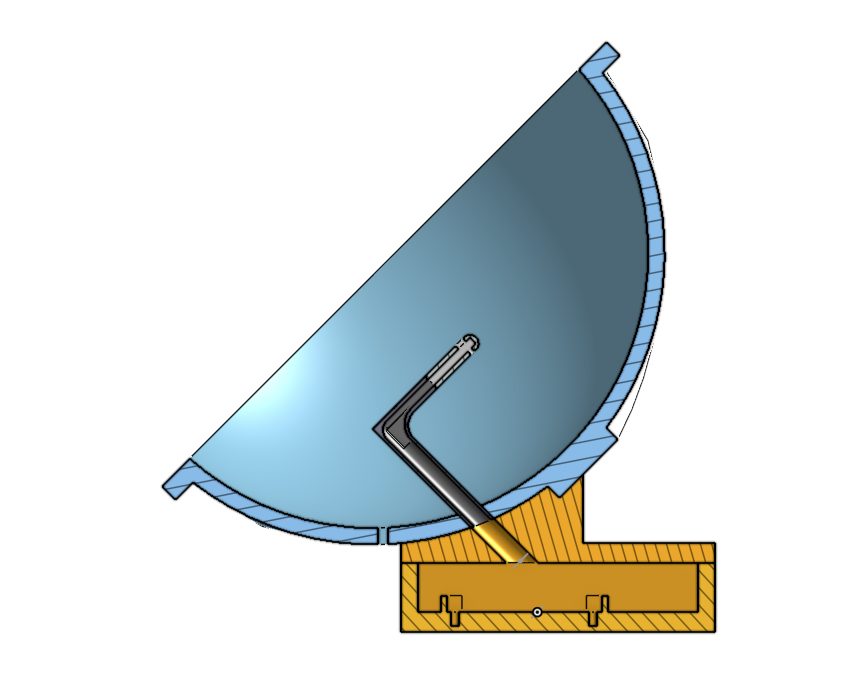
The underlying geometry of a paraboloid provides a defined focal point: acoustic waves arriving approximately parallel to the reflector’s axis are redirected toward that focal region.
This made the geometry critical to the performance of the sensing system.
The reflector therefore had to be designed around parameters such as:
- aperture diameter
- focal length
- focal ratio
- depth
- microphone placement
- reflector curvature
- mounting geometry
- structural stiffness
The microphone could not simply be positioned approximately in front of the dish. Its position relative to the calculated focal point directly influenced how effectively incoming acoustic energy was concentrated.
I used CAD to construct and refine the reflector geometry and the supporting mechanical architecture required to hold the microphone at the focal location.
Concept design
Concept design prepared before the first physical prototype. This sheet is AI-generated and was used as an early design reference, not as fabricated hardware.
Mechanical CAD and integration
The CAD work involved more than modeling the parabolic surface itself.
The assembly required a rigid and repeatable interface between the reflector, microphone, electronics, and mounting structure. The microphone needed to remain mechanically constrained at the intended focal position while maintaining the overall geometry of the collector.
This introduced several mechanical considerations:
- Focal-point accuracy
- Microphone positioning
- Acoustic coupling
- Signal quality
Even relatively small mechanical deviations could change the relationship between the microphone and the reflector’s focal region.
The mechanical design therefore had to account for dimensional tolerances, mounting interfaces, structural rigidity, and repeatability.
The design was repeatedly refined through CAD iteration and physical testing, with changes made based on measured behavior rather than treating the initial geometry as final.
First prototype
The first physical prototype was built for testing and investor presentations — a working collector assembly that could demonstrate the directional acoustic approach before the final product packaging was complete.
Custom microphone integration
A custom microphone was positioned at the focal point of the reflector to capture the concentrated acoustic signal.
The microphone effectively acted as the sensing element at the end of the acoustic collection chain.
This required careful consideration of:
- microphone positioning
- physical mounting
- acoustic exposure
- mechanical isolation
- electrical interfacing
- cable routing
- enclosure integration
The objective was to preserve the directional characteristics produced by the reflector rather than introducing unnecessary mechanical or acoustic interference around the sensing element.
Custom electronics
The microphone was interfaced to a custom-designed electronics board containing the processing hardware required to run the local AI inference pipeline.
This board acted as the bridge between the analog acoustic sensing system and the computational subsystem.
The architecture therefore moved through several domains:
- Acoustic pressure
- Microphone transduction
- Electrical signal
- Digital representation
- AI inference
Designing the system around a custom board also meant considering the physical and electrical constraints of integrating the sensing and compute components into a single field-deployable assembly.
The electronics had to provide a suitable acquisition path for the microphone while also supporting the compute hardware and its associated software environment.
Custom board
Local AI inference
One of the most technically interesting aspects of the project was that the classification system was designed to run locally.
Rather than continuously transmitting raw acoustic information to a remote service, the sensing platform was built around a dedicated onboard compute device capable of running a specially configured local model.
The model was not simply deployed with default parameters.
A significant amount of work went into configuring and tuning the inference environment so that the system could interpret acoustic information in a way that was useful for the intended classification task.
The objective was to distinguish between drone acoustic signatures and ordinary environmental acoustic activity.
This required the model and the surrounding pipeline to be evaluated against real-world sound rather than only idealized examples.
Model configuration and tuning
The local model required substantial configuration and experimentation.
The acoustic environment contains considerable variability: wind, traffic, machinery, voices, wildlife, HVAC systems, mechanical equipment, and other background sources can all produce signals that potentially resemble portions of a drone’s acoustic signature.
The model therefore could not simply be evaluated against a clean “drone vs silence” problem.
Testing focused on determining how the inference system behaved under increasingly realistic environmental conditions and how effectively it separated relevant acoustic characteristics from background interference.
Parameters and system configuration were adjusted repeatedly while comparing the resulting classification behavior.
This made model deployment itself an engineering problem rather than a one-time software installation.
Acoustic signal characterization
The sensing system ultimately depends on the quality of the acoustic signal delivered to the inference layer.
A poor mechanical configuration can degrade the signal before software ever sees it.
That made it necessary to consider the complete acquisition chain:
- Sound source
- Propagation
- Reflector
- Focal concentration
- Microphone
- Electronics
- Inference
The reflector geometry determined how directional information was emphasized, while microphone placement affected how much of the concentrated energy was captured.
The resulting signal then became the input to the classification system.
This is why the project required simultaneous iteration across mechanical, electronic, and software domains.
Environmental testing
A substantial part of the development process consisted of long-duration testing.
The system needed to be tested against real environmental sound rather than assuming the classifier would generalize automatically.
Testing involved exposing the sensor to different combinations of background noise and target acoustic signatures and examining how the local inference system responded.
The goal was to identify false positives, false negatives, environmental interference, and other failure modes.
This created an iterative loop:
- Build
- Deploy
- Record
- Analyze
- Tune
- Rebuild
- Retest
The long testing cycle was particularly important because acoustic classification is highly dependent on the environment in which the sensor is deployed.
Mechanical + AI co-design
One of the central engineering lessons from the project was that the mechanical and AI systems could not be optimized independently.
Improving the classifier does not compensate indefinitely for a poor acoustic front end.
Likewise, an excellent reflector geometry does not guarantee accurate classification if the downstream inference pipeline is insufficiently tuned.
The system therefore required a co-design approach:
- Mechanical geometry
- Signal quality
- Feature representation
- Model inference
- Classification reliability
That made the project fundamentally multidisciplinary.
Directionality
The parabolic reflector also provided an important spatial characteristic: directional sensitivity.
Rather than using an omnidirectional microphone by itself and attempting to infer source direction entirely through signal processing, the collector provided a physical mechanism for concentrating sound arriving from the reflector’s preferred direction.
This effectively created an acoustic front end with spatial selectivity.
That has potential downstream applications where the system needs to determine whether a target sound is originating from a particular region rather than merely detecting its presence somewhere in the environment.
Data pipeline
The broader software concept can be represented as:
- Acoustic environment
- Parabolic acoustic collection
- Focal-point microphone
- Signal acquisition
- Embedded processing hardware
- Local model inference
- Drone / non-drone classification
- Output for downstream use
Keeping the processing local also reduces the dependency on network connectivity during inference and allows the sensor to operate as a self-contained edge-processing device.
Final product
After prototype testing and iterative refinement, the work converged on a packaged final product that integrated the parabolic collector, focal microphone, and onboard electronics into a deployable sensing unit.
Final product
Iterative engineering
I approached the project experimentally rather than assuming that the initial design would be sufficient.
The development process consisted of repeatedly modifying the physical design, evaluating acoustic performance, adjusting the electronics and inference configuration, and comparing the resulting system behavior.
CAD revisions were driven by physical requirements.
Model configuration was driven by observed classification behavior.
Testing was driven by real environmental conditions.
The project therefore followed a genuine engineering feedback loop rather than a simple design-and-deploy process.
Engineering challenges
Several different engineering problems had to be solved simultaneously:
- The reflector needed a geometry capable of concentrating acoustic energy toward a controlled focal region.
- The microphone needed to remain accurately positioned relative to that focal point.
- The electronics needed to capture and process the microphone signal reliably.
- The compute platform needed to support local inference.
- The AI system needed to distinguish target acoustic signatures from a highly variable background environment.
- And the complete assembly needed to remain mechanically stable and repeatable during testing.
Solving any one of these independently was insufficient; the value came from integrating all of them into one functioning sensing platform.
What I learned
This project gave me experience working on a system where mechanical engineering directly influenced machine-learning performance.
A CAD decision could change the acoustic response.
An electronics decision could affect the quality of the signal delivered to the model.
A model configuration change could alter how much signal quality was required from the physical sensing system.
It reinforced the importance of looking at an engineering system as a chain of dependent subsystems rather than treating hardware, software, and AI as separate disciplines.
It also gave me practical experience with edge AI, where computation is pushed toward the sensor rather than relying on a remote inference service.